Is Your Commercial HVAC Schedule Still Right for Your Building?
An HVAC system can be running properly and still be operating at the wrong times. For Southern California property owners and managers, changing tenant hours, weekend access, and temporary thermostat overrides are good reasons to revisit the schedule.
As part of your commercial HVAC maintenance plan, review how the building actually operates before budgeting for equipment upgrades. A few well-chosen checks can help identify unnecessary runtime and give your service team clearer information about comfort complaints.
1. Start with actual occupancy
Write down when each tenant or department arrives and leaves, including cleaning crews, deliveries, and weekend staff. Compare those hours with the schedules programmed into the thermostats or building controls.
For example, an office that recently stopped opening on Saturdays may still have its old cooling schedule. Another tenant may now arrive earlier than the system’s scheduled start.
Identify spaces that need continued conditioning before making changes. Have your HVAC service team confirm which schedule adjustments are appropriate for the equipment and the spaces it serves.
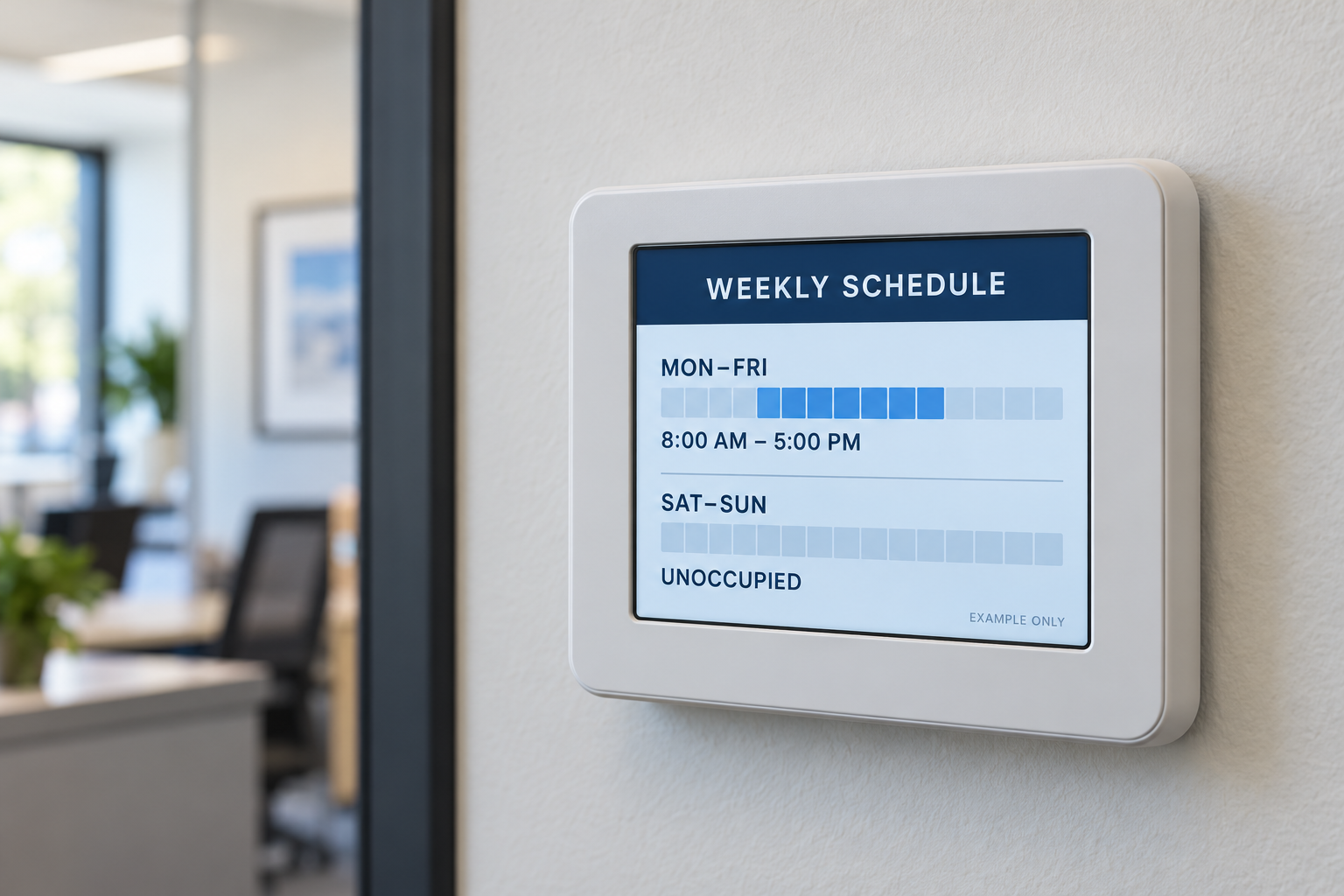
Illustrative thermostat schedule. Unoccupied settings can keep cooling available at a higher room-temperature target.
2. Use unoccupied cooling settings that fit the building
Unoccupied does not automatically mean switching the system completely off. A higher room cooling setpoint can keep cooling available while reducing demand—for example, 77–78°F instead of 72°F. These are illustrative space-temperature settings, not chilled-water temperatures or universal recommendations.
Have your service team select settings based on humidity, sensitive equipment or process loads, and the time needed to restore comfort before occupants return.
For chiller plants, follow the approved building automation sequence. Chillers and pumps may stage down or stop when demand allows; keeping controls available does not mean running equipment continuously. A planned shutdown may suit some buildings, while others need continued conditioning and protective functions.
Check conditions before opening and after closing, and document recurring problems. The goal is operation that matches the building’s needs.
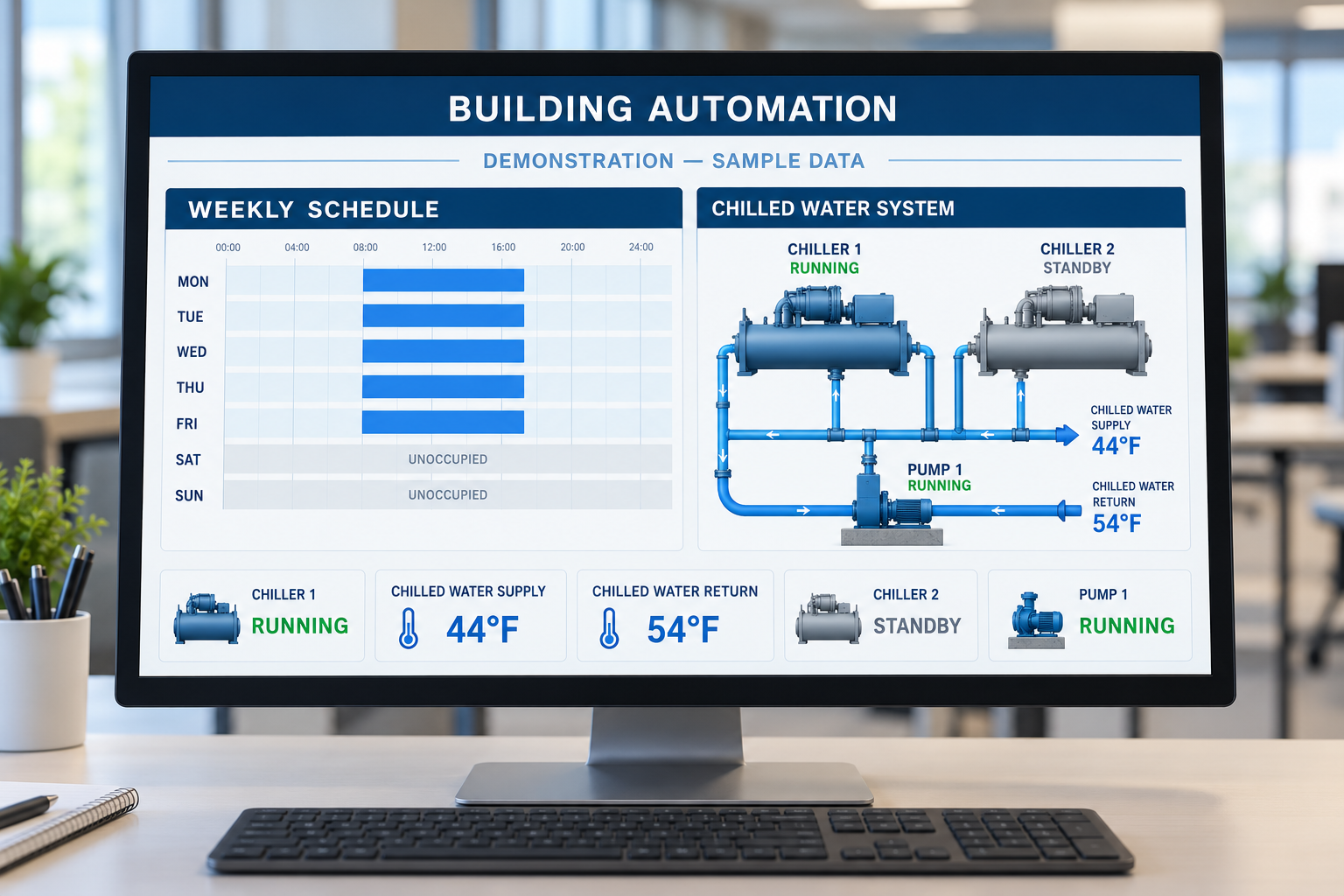
Illustrative BAS dashboard with sample data. Actual chiller schedules, operating sequences, and temperature settings depend on the building and equipment.
3. Review thermostat accuracy and temporary overrides
A displayed temperature is only useful if the thermostat is reading accurately. Ask your technician to check questionable readings and review temperature settings.
Also look for temporary holds left behind after an evening meeting or special event. Establish who can request an override, how long it should last, and who confirms that normal scheduling resumes.
Keep a short record of approved changes. That gives the next manager or technician something reliable to work from.
4. Keep maintenance in the picture
Scheduling cannot compensate for neglected equipment. Dirty filters, dirty coils, and blocked vents can affect system performance even when operating hours are correct.
Keep supply and return grilles clear of boxes, furniture, and stored materials. Have your maintenance provider review filter condition, coil cleanliness, and any recurring service concerns.
If a space remains uncomfortable after a schedule correction, document it and arrange further evaluation rather than repeatedly extending runtime.
5. Turn the review into a practical plan
Create a one-page list of approved operating hours, unresolved complaints, maintenance needs, and the person responsible for each follow-up. Revisit it when tenants, hours, or space use change.
Compare comfort and operating patterns after adjustments. The goal is a schedule that supports the building’s actual needs, with clear reasons for when equipment runs.
Need help reviewing your building’s HVAC operation or maintenance priorities? Call ZAFI Air Conditioning and Consulting, Inc. at (909) 510-2256 to discuss your property.
Explore our commercial HVAC services in Southern California.